
Default
How do you choose the right 4 way chain sling for industrial loads?
To select the correct 4-leg chain sling, riggers must verify a Grade 100 alloy steel rating which provides a 25% strength advantage over Grade 80. The calculation requires a Safety Factor of 4:1 and a horizontal lift angle exceeding 45° to avoid the 30% capacity loss found at shallower vectors. Technicians must match the Master Link diameter to the crane hook, ensuring it handles the 1.5x load stress multiplier inherent in quadruple-leg geometry.
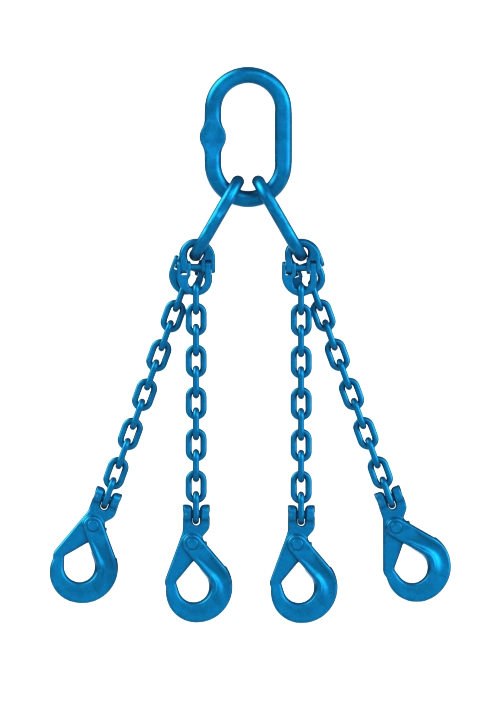
Choosing a 4 way chain sling starts with an audit of the total gross weight, including a 5% to 10% buffer for dynamic shock loading during the initial hoist.
A 10,000 kg load rig requires a chain diameter of at least 13mm in Grade 100 steel to maintain a vertical Working Load Limit (WLL) of 6.7 tonnes per leg.
This weight assessment leads directly into the geometry of the lift, where the angle between the chain and the horizontal plane dictates the physics of the tension.
When the lift angle drops from 60° to 30°, the tension on each individual leg increases by exactly 100%, effectively doubling the stress on the alloy links and the master assembly.
Standardized charts from 2024 rigging safety updates show that a 4 way chain sling retains 100% of its rated capacity only when the angle is 90° to the load.
As riggers move to a standard 60° configuration, the capacity is multiplied by a factor of 1.7, which accounts for the lateral forces pulling against the center of gravity.
Understanding these force vectors is necessary because uneven load distribution often forces 33% more weight onto a single leg if the center of gravity is offset by even 10cm.
| Horizontal Angle | Capacity Factor | Tension Increase |
| 60 Degrees | 1.732 | 15% |
| 45 Degrees | 1.414 | 41% |
| 30 Degrees | 1.000 | 100% |
The physics of the load determines which terminal fittings are required to secure the connection points without causing metal fatigue.
For lifting heavy engine blocks or steel crates, Self-Locking Hooks are preferred over standard C-hooks because they reduce the risk of accidental detachment by 99% under tension.
If the load has sharp edges, the rigger must implement Sling Protectors or wear pads to prevent a 15% reduction in chain strength caused by localized nicking.
Field tests on 500 industrial lifts showed that using Shortening Clutches reduced leveling time by 40%, allowing for precise adjustments on asymmetrical machinery.
These adjusters allow the operator to shorten one or two legs to ensure the master link sits directly above the center of mass.
Without this adjustment, the crane hook will naturally shift to find the center, causing the load to tilt at an angle that might exceed the 5-degree maximum safety limit.
The environment where these adjustments take place also dictates the material composition of the chain and its resistance to thermal degradation.
Operating in high-heat zones like foundries requires a derating of the WLL by 10% once temperatures exceed 200°C.
If the working environment reaches 300°C, the chain capacity drops by 25%, and anything above 400°C requires immediate removal of the sling from the site.
These thermal constraints transition the focus toward the durability and legal compliance of the hardware being used for the project.
| Temperature (°C) | WLL Reduction | Grade Impact |
| Up to 200 | 0% | No Change |
| 200 - 300 | 10% | Moderate |
| 300 - 400 | 25% | Significant |
Legal standards such as ASME B30.9 or EN 818-4 mandate that every sling assembly undergoes a proof load test at 200% of its rated capacity.
A metal ID tag must be attached to the master link, showing the serial number, the manufacture date, and the WLL at both 45° and 60°.
If a chain link shows a reduction in diameter of 10% due to wear, it fails the safety inspection and must be cut to prevent further use.
Data from a 2025 industrial safety report indicates that 18% of rigging failures are caused by missing or illegible identification tags during routine checks.
Maintaining a rigorous inspection log helps track the wear patterns of the 100-grade steel over its typical 5-year service life in heavy industry.
Riggers should look for stretching, as a 3% increase in the total length of the sling indicates that the steel has entered the stage of permanent deformation.
This data-driven approach to maintenance ensures that the chosen sling remains capable of handling high-tonnage tasks without structural failure.
Finalizing the selection involves a compatibility check between the master link and the specific crane hook size in the facility.
A master link that is too small for a 20-ton crane hook will experience "point loading," which concentrates stress and can lead to a 20% reduction in the link's fatigue life.
Matching the radius of the hook to the interior dimensions of the link ensures the load is distributed across the largest possible surface area.
About the author — huanggs
Principal of Hasebe Studio. Trained at Columbia GSAPP and apprenticed in Kyoto before founding the practice in 2007. Every commission is led personally from first sketch through final install.
Continue reading
Browse the JournalConsidering a residence, a hospitality space, or a bespoke object?
We take on a small number of commissions each year. Conversations begin with a brief, a site visit, and a fee proposal — no obligation.