
Referral Math for Miners Who Run Their Own Rigs
A referral link is a small piece of infrastructure: it records who arrived from where. For a miner, the useful question is not how many clicks it gets but whether the people behind those clicks are actually running hardware. At 47 TH/s, current conditions produce 2.108e-05 BTC a day, worth $1.79 at $84,692 per BTC, or $1.71 after the listed 4% on the block-reward component.

Key takeaways
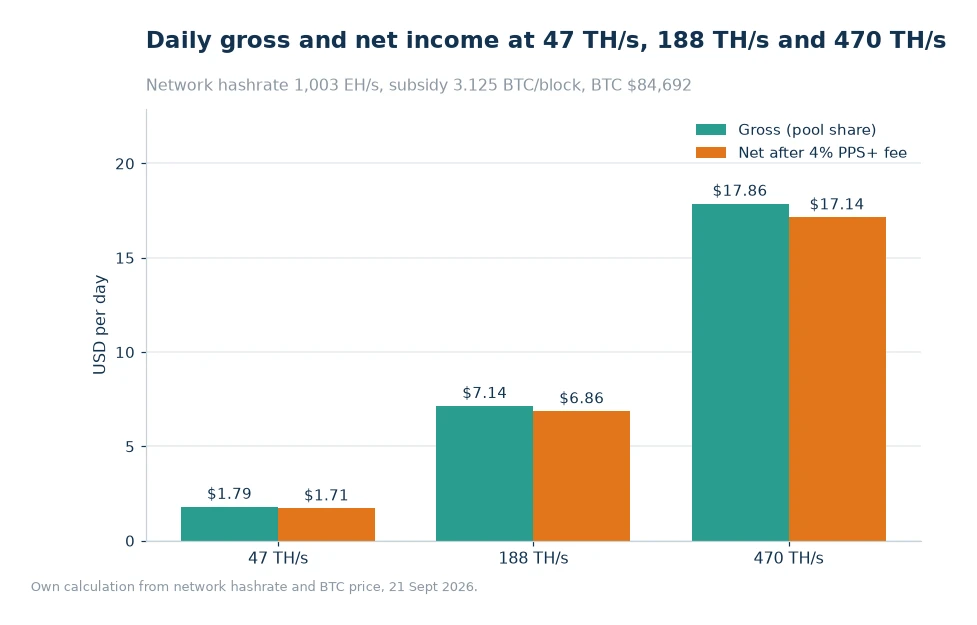
- At 47 TH/s the daily payout is 2.108e-05 BTC, or $1.79 gross and $1.71 net of the listed 4% on the block-reward component.
- At 470 TH/s the same inputs give 0.00021084 BTC a day, $17.86 gross and $17.14 net.
- A referral link records an arrival; it does not change the payout formula or the listed rates.
- The people most likely to use a mining referral are already comparing hardware, power and payout timing.
Why a referral link is a mining topic
Most referral conversations happen between people who already share a hobby or a business. In mining, that means the audience is small and technical. They want to know the payout method, the listed rates and whether the account can hold several coins. A link that arrives without that context reads like advertising, and a link that arrives with a worked example reads like a recommendation from someone who has done the arithmetic.
That is the practical case for treating referral as an extension of mining content rather than a separate marketing channel. The same daily output figures that help an operator decide whether to add a machine also help a reader decide whether the pool is worth a closer look. The link is just the step at the end of that explanation.
What the link does and does not promise
The ViaBTC Referral page is the place where the program's terms live, including eligibility and how tracking works. The link itself does one job: it associates a new sign-up with the account that shared it. It does not change the network hashrate, the block subsidy or the listed pool rates, and it does not make a marginal rig profitable.
That distinction matters for how the link is described. Saying "sign up here and start mining" is accurate. Saying "sign up here and earn a fixed amount" is not, unless the program page states that amount for that user. The safe description sticks to what the link does and points to the page for the rest. It also keeps the conversation focused on the mining, which is the part the reader can verify.
The audience sits in hashrate bands
Miners think in terahash and petahash, so a referral conversation that uses those units lands better than one about generic sign-ups. The three rows below are the same kind of small-farm arithmetic an operator would run before buying. The network inputs are held constant, and the net column applies only the listed 4% to the block-reward component.
| Hashrate | BTC per day | Gross USD per day | Net USD per day |
|---|---|---|---|
| 47 TH/s | 0.00002108 | $1.79 | $1.71 |
| 188 TH/s | 0.00008435 | $7.14 | $6.86 |
| 470 TH/s | 0.00021084 | $17.86 | $17.14 |
The middle row is four times the first, and its gross is four times $1.79, or $7.16 before rounding. The top row is ten times the first, and its gross is ten times $1.79, or $17.90 before rounding. A reader who is comparing a single machine with a small rack can place themselves on this ladder in seconds, which is more useful than a generic claim about passive income.
Disclosing the link without hype
The simplest disclosure is a sentence: "This is my referral link, and I may receive a benefit if you sign up through it." Put it near the link rather than in a footnote. Readers who run hardware are used to reading terms, and they will notice an omission faster than they will notice a modest reward. The disclosure also protects the recommendation from looking like impartial advice when it is not.
After the disclosure, give the reader something they can use without signing up. The payout formula, the difference between PPS+ and PPLNS, and the daily figure at their hashrate are all useful on their own. A referral that leads with a calculator result is more credible than one that leads with a bonus, because the reader can check the result against their own inputs.
Tracking and follow-up
Tracking tells you whether the link is reaching miners or browsers. If the sign-ups are arriving but the accounts stay empty, the audience may be curious rather than committed. If the accounts start submitting shares, the link is reaching people with hardware. Neither outcome is a reason to change the payout method; both are reasons to adjust the content around the link.
Follow-up should stay on the same terms. A short note about the next difficulty adjustment, or a reminder that PPS+ settles hourly while PPLNS waits for 6 confirmations, is more useful than a repeated call to sign up. The goal is to be the person who explained the arithmetic clearly, not the person who posted the link most often.
Worked example
Take 47 TH/s and follow the chart arithmetic with the inputs read on 21 Sept 2026.
- Daily BTC per TH/s is 450 divided by 1,003,000,000, which equals 4.4865e-07.
- Multiply by 47: 4.4865e-07 times 47 equals 2.1087e-05 BTC, shown as 2.108e-05.
- Multiply by the BTC price: 2.1087e-05 times $84,692 equals $1.79 gross.
- Apply the listed 4% to the block-reward component: 4% of $1.79 is $0.07, leaving $1.71 net.
- Multiply by four for 188 TH/s: 0.00008435 BTC, $7.14 gross and $6.86 net.
- Multiply by ten for 470 TH/s: 0.00021084 BTC, $17.86 gross and $17.14 net.
- Across 30 days the top row nets about $514.20, which is the kind of figure a small farm can compare with its power bill.
Point to the program, not just the link
Miners who want to do more than share a sign-up link can look at the ViaBTC Ambassador Program, which is a separate route with its own application. The existence of both routes is useful context: a referral suits an operator who occasionally recommends a pool, while an ambassador arrangement suits someone who publishes regularly and wants a formal relationship.
Either way, the arithmetic comes first. A reader who understands that 47 TH/s produces 2.108e-05 BTC a day is in a better position to judge any offer, including one that arrives through a link. That is the standard the content should meet before it asks for a click.
Frequently asked questions
Does a referral link change the pool fee?
No. The listed rates still apply to the payout: 4% on the PPS-settled block reward and 2% on the transaction-fee component under PPS+, or 2% on both combined under PPLNS. The link only records who referred the account.
Who is the right audience for a mining referral?
People already comparing hardware, power rates and payout timing. They can use a daily output figure such as 2.108e-05 BTC at 47 TH/s to judge whether a pool fits their setup, which makes the conversation concrete.
Can I share a referral link and still write objectively?
Yes, if the link is disclosed clearly and the article stands on its own without it. Give the reader the formula, the listed rates and the daily figures first, then identify the link as a referral rather than presenting it as neutral advice.
Share the arithmetic, then the link
Write the daily output for the hashrate your audience is likely to run, show the listed charge, and disclose the link in plain words. At 47 TH/s the gross is $1.79 a day and the net is $1.71, which is a modest but checkable figure. A referral built on that kind of clarity reaches miners who are deciding with numbers, and those are the readers worth having.
Sources: the ViaBTC referral page for the program terms and the pool fee schedule for the listed 4% and 2% rates. Network hashrate 1,003 EH/s, difficulty 132.76 T, subsidy 3.125 BTC per block, 450 BTC daily and BTC $84,692 were read 21 Sept 2026, published 22 Oct 2026[1]. Every dollar figure is arithmetic on those inputs and moves when they move.